
Ohio State study highlights new model for teaching team-based care in clinical rotations
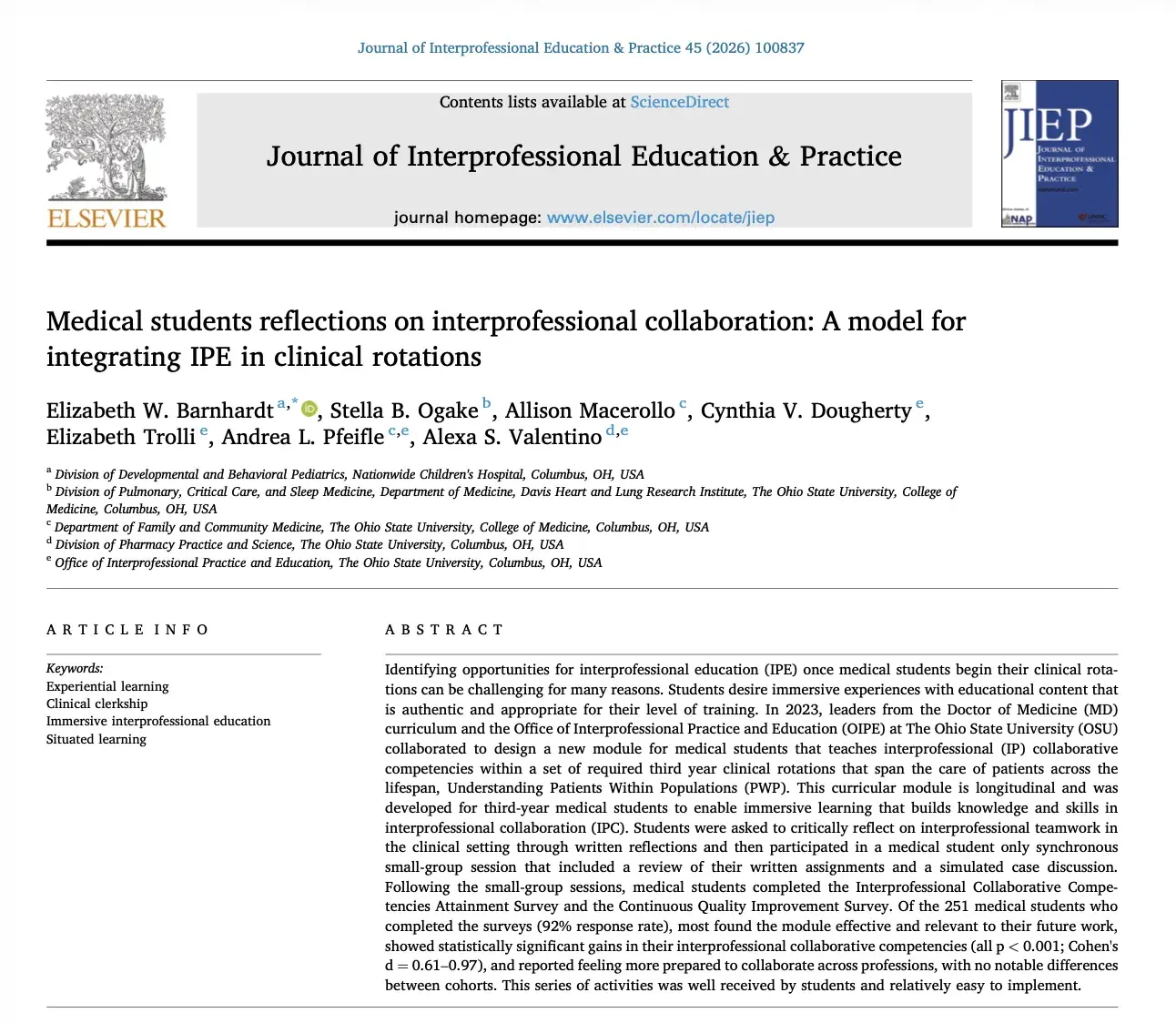
A collaborative team from The Ohio State University Office of Interprofessional Practice and Education and The Ohio State University College of Medicine has published new findings demonstrating the success of a new approach to interprofessional education in clinical settings.
The paper, titled “Medical students reflections on interprofessional collaboration: A model for integrating IPE in clinical rotations,” was published in the Journal of Interprofessional Education & Practice. Supported by a grant from The Ohio State University Michael V. Drake Institute for Teaching and Learning, the research tracks outcomes from a new entry-to-practice interprofessional education experience in the curriculum, which was launched in 2024 for third-year medical students.
Bringing teamwork reflection to real world care
While early healthcare education often teaches interprofessional collaboration in classroom or simulated settings, finding meaningful opportunities for collaborative learning once learners begin clinical rotations can be challenging.
To address this gap, leaders embedded a longitudinal learning module into the Understanding Patients Within Populations Ring (a type of clinical rotation) in the third-year medical student curriculum. This is a 14-week rotation covering pediatrics, family medicine, and elective specialties. Throughout the rotation, medical students engage directly with healthcare partners in authentic patient-care settings. Through written reflections, learners consider their experiences from an interprofessional perspective. Learners examine team dynamics in clinical settings, identifying both strengths and opportunities to improve team culture. Additionally, they actively engage with other healthcare professionals and reflect on these interactions and the influence of other clinicians on patient care and learning. Learners then participate in facilitated small-group debriefs that connect their rotation experiences to real-world leadership and collaborative care through a pediatric case conference.
Outcomes show measurable growth in collaborative practice
Across four student cohorts, the module helped students better understand team-based care and build the collaboration skills they will need in practice. The authors reported significant gains across all items on the Interprofessional Collaborative Competency Attainment Survey (ICCAS-R), showing that students did more than recognize the value of teamwork; they developed greater confidence in applying it.
That growth was both statistically significant and practically meaningful, with moderate-to-strong effect sizes in areas such as role clarification, conflict resolution, and communication. Student feedback reinforced the findings: 89% rated the module as effective or very effective, and the same percentage agreed that the skills they practiced are directly relevant to their future medical careers. For patients, training clinicians in these core teamwork skills creates the conditions for safer, more coordinated care by reducing the communication breakdowns that commonly lead to gaps in care.
Because of its effectiveness and ease of implementation, the model is already being adapted for other health professions programs at Ohio State.
The research team includes: